Yi-Jing Sie 謝宜靜

About Me

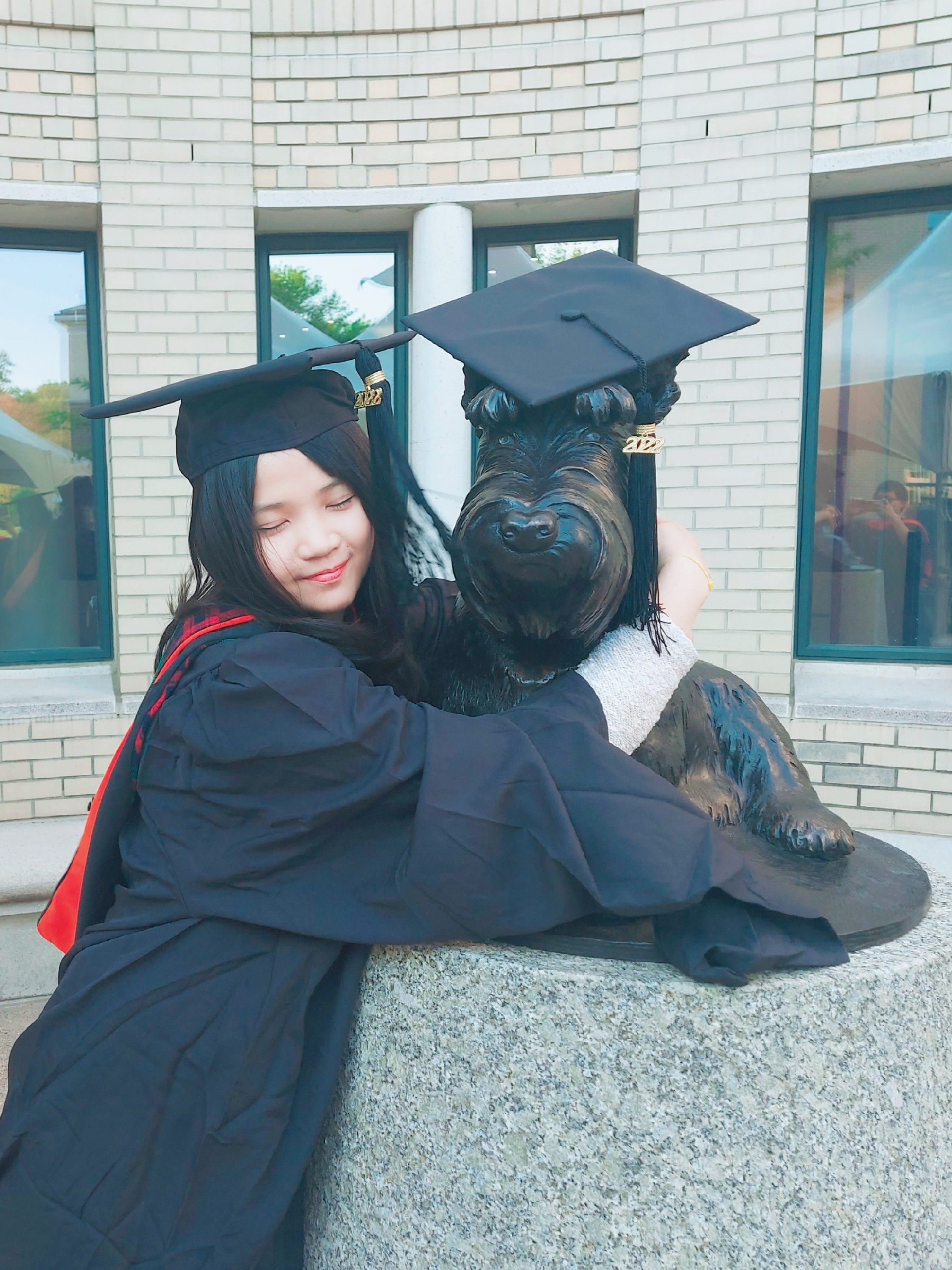
A photo of me and Scotty


Hi! I am a senior deep learning algorithm engineer at an AI ASIC startup, Neuchips, with a master's degree in Electrical and Computer Engineering from Carnegie Mellon University and a bachelor's degree in Electrical Engineering from National Taiwan Ocean University.

Highlights of my work: Spearheaded and transformed a one-off project addressing real-time industrial anomaly detection problems into an official company product, leveraging deep learning expertise to build a customized AI solution that boosts detection accuracy by 36% and reduces costs by 70%, compared to clients' in-house systems.

More details can be found here: NeuSight™

Work Experience

Neuchips

Senior Deep Learning Algorithm Engineer Jan 2025 - Present

Deep Learning Algorithm Engineer Dec 2022 - Dec 2024

► Designed and developed a tailored AI solution in 6 months that surpassed a world-leading semiconductor foundry’s in-house defect inspection system for rare lithography-stage wafer defects, achieving a 6x boost in inference speed and a 36% increase in accuracy, with projected savings of ~70% in server space requirements and 70% in power consumption

► Turned the one-off project of building tailored AI solutions for semiconductor defects into an official company product, NeuSight™, by successfully securing 2 subsequent project contracts with the world-leading semiconductor foundry in 1 year as a result of consistent outstanding AI performance, fostering expanded partnerships with other major semiconductor foundries in the market, significantly contributing to the company's revenue growth and profitability

► Developed high-performance web APIs to deploy AI solutions, enabling parallel request handling and real-time defect monitoring; achieved a peak throughput of 1.5 requests/second and successfully processed 35k+ wafers/day across multiple semiconductor fabs for 7 days

► Achieved a 2x boost in inference speed through multithreading, pipeline parallelism, and NVIDIA® TensorRT™, while maintaining equivalent accuracy

► Promoted to senior engineer in 2 years due to exceptional performance and organizational impact - ahead of schedule by 12 months

► Cultivated a new major client relationship within the semiconductor market by securing 3 consecutive project contracts for various semiconductor defects within 1 year

► Shipped tailored AI solutions into production via Docker, passing customer stress tests with real-time data from semiconductor fabs

► Authored a patent on effective and efficient mechanisms specifically designed to detect semiconductor defects that occur during the manufacturing process (under internal review)

Carnegie Mellon University

Research Assistant (Internship) Jun 01 2021 - Aug 31 2021

► Study causal reinforcement learning that aims to utilize causal structures derived from training data to enhance the performance of machine learning algorithms

► Composed a brief review of multimodal data fusion and multi-task learning as means to learning causal representation for multimodal data

Personal Side Projects

Decouple Qwen 1.8B from transformers

A repo that removes Qwen 1.8B's dependency on the most widely used open-source LLM library - transformers [Link]

Byte-Pair Encoding tokenization

A standalone colab notebook implements and explains how byte pair encoding tokenization algorithm works on Mandarin Chinese [Link]

Model Conversion (ONNX & TensorRT™)

Model optimization tutorials for converting a pretrained Pytorch model into ONNX and TensorRT to speed up deep learning inference [Link]

Academic Research Projects

On Detecting Rare Patterns

Advisor: Dr. Christino Tamon (Clarkson University)

Sep 2018 - June 2019

► Studied the paper Finite Sample Complexity of Rare Pattern Anomaly Detection to reproduce the results by implementing the algorithms from scratch

► Diagnosed algorithm limitations on imbalanced categorical datasets and devised an improved algorithm that outperformed other established outlier detection algorithms including GMM, PPCA, LSA, LOF, and Isolation Forest

Automatic Fish Detection and Tracking in Underwater Videos

Advisor: Dr. Jung-Hua Wang (National Taiwan Ocean University)

Sep 2017 - Aug 2018

► Contributed to a government-subsidized research project, Applying Artificial Intelligence (AI) Techniques to Implement a Practical Smart Cage Aquaculture Management System (AI技術應用於智慧化養殖系統的建置), funded by the Ministry of Science and Technology of Taiwan

► Trained a Faster R-CNN with Inception-V2 model to detect all fish and track a target fish in complex, changeable underwater environments from recorded video footage

► Designed a robust and efficient tracking mechanism to continuously track the target in real-time even under occlusion

Coursework

Introduction to Deep Learning

CMU ECE - 18786

► Built a character-based Seq2Seq model using LSTMs with attention & teaching-forcing mechanisms to retrieve a clear diagonal attention plot for validation data [Link - see part 2]

► Built a regularized LSTM model for next word prediction and text generation tasks [Link - see part 1]

► (Kaggle Competition: 14/300+) Built a stacked LSTM model and employed a CTC beam search decoder for speech recognition competition [Link - see part 2]

► Implemented from scratch a multi-layer Elman Recurrent Neural Network, Gated Recurrent Unit, and Connectionist Temporal Classification loss entirely in NumPy [Link - see part 1]

► (Kaggle Competition: 14/300+) Implemented from scratch a ResNet50 model for face classification and face verification competitions [Link - see part 2]

► Implemented from scratch Conv1D & Conv2D models entirely in NumPy [Link - see part 1]

► (Kaggle Competition: 5/300+) Built a MLP model to predict phoneme state labels from Mel spectrogram frames for speech recognition competition [Link - see part 2]

► Implemented from scratch a Multi-Layer Perceptron (MLP) model entirely in NumPy, including the forward pass and backward propagation with gradient calculations for a linear layer, Sigmoid activation, Tanh activation, ReLU activation, softmax cross-entropy loss function, and batch normalization [Link - see part 1]

Introduction to Machine Learning

CMU ECE - 18661

► Studied the theories of classical machine learning algorithms for supervised learning (linear models, kernel methods, decision trees, neural networks) and unsupervised learning (clustering, dimensionality reduction), as well as theoretical foundations of machine learning (optimization, learning theory) [Course info link]

► Implemented machine learning algorithms from scratch, including Support Vector Machine, Hidden Markov Model, Principal Component Analysis, Gaussian Mixture Model, etc., to solve real-world problems

Optimization

CMU ECE - 18660

► Studied the theories and algorithms for convex optimization problems [Course info link]

► Implemented different iterative thresholding algorithms to recover corrupted images by solving sparse image optimization problem, achieving less than 0.015 normalized MSE [Link - group project]